Mad politics and anthropologies of the state
Keywords:
mad politics, state, affect, political anthropology, Begoña AretxagaAbstract
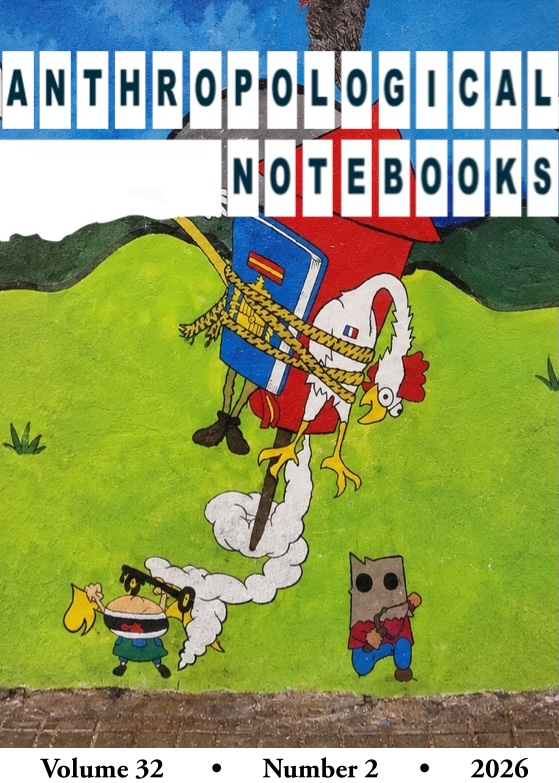
Departing from Begoña Aretxaga’s notion of maddening states, this special issue examines the contemporary dynamics of irrational, spectacular, and affectively charged forms of rule and political leadership. We reframe “madness” not as pathology, but rather as a constitutive feature of sovereign power illuminating how state authority is produced through fantasy and affects as much as through apparent bureaucratic rationality. The issue brings together three interconnected themes: the state as a site of politics oscillating between fear and desire, the methodological challenges of capturing its affective and even haunting dimensions, and the persistence of colonial legacies within contemporary regimes of sovereignty. Ethnographically sustained contributions on state apparatuses and representations show the importance of mad politics in three contemporary settings. Bäckström’s study of a Blang village on the China–Myanmar border approaches the state as a social being with its own spectral life. Similarly, Soğancı and Sultan’s comparison of northern Lebanon and Northern Cyprus traces how state promises become objects of desire and political imagination, even if they remain perpetually unfulfilled, exposing the contradictions and affective tensions underpinning political processes. Finally, Carapeto’s examination of Portuguese border control shows how passports operate as biographical devices through which sovereignty is unevenly performed, playing with the irrational while reproducing colonial hierarchies through seemingly routine-driven administrative procedures. Across these contributions, the state emerges not as a stable, rationally driven institution, but as an ambivalent instance shaped by diverse forms of mad politics.
Downloads
Published
Issue
Section
License
Copyright (c) 2026 Anthropological Notebooks

This work is licensed under a Creative Commons Attribution 4.0 International License.